


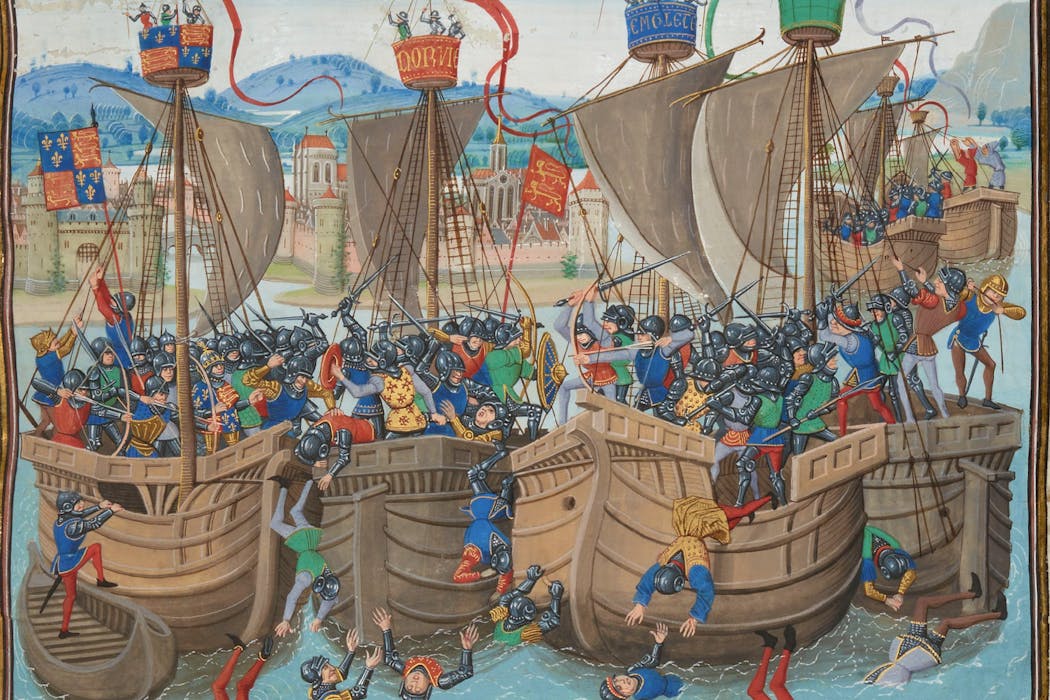
The Battle of Sluys during the 100 year war, as depicted by Jean Froissart in the 15th century. National Library of France
When you picture medieval warfare, you might think of epic battles and famous monarchs. But what about the everyday soldiers who actually filled the ranks? Until recently, their stories were scattered across handwritten manuscripts in Latin or French and difficult to decipher. Now, our online database makes it possible for anyone to discover who they were and how they lived, fought and travelled.
To shed light on the foundations of our armed services – one of England’s oldest professions – we launched the Medieval Soldier Database in 2009. Today, it’s the largest searchable online database of medieval nominal data in the world. It contains military service records giving names of soldiers paid by the English Crown. It covers the period from 1369 to 1453 and many different war zones.
We created the database to challenge assumptions about the lack of professionalism of soldiers during the hundred years war and to show what their careers were really like.
In response to the high interest from historians and the public (the database has 75,000 visitors per month), the resource has recently been updated. It is now sustainably hosted by GeoData, a University of Southampton research institute. We have recently added new records, taking the dataset back to the late 1350s, meaning it now contains almost 290,000 entries.
This data is mainly drawn from muster rolls (lists of names of soldiers comprising the military force) of men-at-arms (soldiers with full armour and a range of weapons) and archers. We can even see the little dots used by officials taking the muster to confirm the soldiers had turned up and had the right equipment. All these soldiers were paid and the Exchequer wanted to be assured it was receiving value for money.
We have also included protections and appointments of attorneys and legal mechanisms to protect local interests while serving overseas. Together, these records provide rich accounts of military activities, allowing for significant conclusions to be drawn. Careers of 20 years and more are revealed. We also see men moving upwards socially because of their good service. For many soldiers, especially archers, this information may be the only record we have of their existence.
The expanded data enables us to explore the garrison of Calais from 1357 to 1459. We can see the high manpower commitment needed to maintain this key English base in northern France. Calais was the gateway through which many great expeditions passed, including that of 1359 when Edward III set out to besiege Reims to be crowned King of France.
The database also allows comparisons with other emerging projects. For instance, we can establish the military experience of rebels in the peasants’ revolt of 1381, a widespread English uprising driven by economic hardship, high taxes and social tensions, ultimately suppressed violently by King Richard II and his government. The data allows many deep dives into the past. It allows historians to demonstrate that, unlike today where the armed forces specialise, the medieval soldier would have served repeatedly across different theatres of war.
We can see expeditionary armies sent to invade France as well as naval campaigns in the English Channel. We also find soldiers in garrisons in Scotland, Ireland and France. Our data has allowed family historians to push their genealogies back further than has been previously possible.
Standout stories
The resource is home to many insightful records of key events and figures. One well known person is Geoffrey Chaucer, author of The Canterbury Tales, which were written between 1387 and 1400. The database holds a number of service records for him. He was a man-at-arms in the garrison of Calais in 1387.
The writer Geoffrey Chaucer is included in the database.
Wiki Commons
This was probably Chaucer’s last foray into military service, but he had considerable experience as a soldier and as a diplomat. He had been in France in 1372, 1377 and 1378. He testified to the Court of Chivalry – a court which settled disputes over coats of arms – in 1386. He told the court that he was then aged “40 and upwards” and “had been armed 27 years”. He gave more details about his service on the Reims campaign of 1359 where he was captured by the French and ransomed.
Records for a man named Thomas Crowe of Snodland in Kent shed some light on his rebellious past. During the peasants’ revolt of 1381, he was accused of “taking up position and throwing great stones” to demolish someone’s house. The database suggests he may have served in France in 1369. He was certainly in the garrison of Calais in 1385 and on a naval campaign in 1387. His military knowledge about trebuchets – a powerful type of counterbalanced medieval siege engine – or giant catapults may explain how he was able to wreak so much destruction in the revolt.
The muster roll for the garrison of Calais in 1357 shows not only the names of men-at-arms and archers but also the support roles needed: mason, locksmith, fletcher (a maker of arrows), bowyer (a maker of bows), plumber, blacksmith, wheelwright, cooper (maker of barrels), ditch digger, boatman, carter and carter’s boy. One record belongs to a tiler – Walter Tyler. Was this the future rebel leader of 1381, Wat Tyler?
We hope the database will continue to grow and go on providing answers to questions about our shared military heritage. We are sure that it will unlock many previously untold stories of soldier ancestors.
Looking for something good? Cut through the noise with a carefully curated selection of the latest releases, live events and exhibitions, straight to your inbox every fortnight, on Fridays. Sign up here.
Adrian R Bell receives funding from UKRI via AHRC.
Anne Curry receives funding from the Leverhulme Trust, and in the past received funding from UKRI via the AHRC .
Jason Sadler receives funding from UKRI via AHRC.




.jpeg)