


The autumn 2025 budget came at a crucial time for the Labour government. With their popularity at record lows, how Labour continues to manage the economy is key for its prospects at the next election.
The chancellor, Rachel Reeves, framed the budget around cutting the cost of living – with good reason. New research from my colleagues and I at the University of Oxford’s Nuffield Politics Research Centre (in collaboration with the Joseph Rowntree Foundation) reveals the prevalence of cost of living concerns among British voters.
Using a nationally representative survey of British adults in April 2025, our analysis shows that just over one-third of the population feel worried about their personal or household finances. This is an experience we call economic insecurity.
Economic insecurity refers to a person’s anxiety about the ability to cope with the financial pressures faced by them and their household. It reflects the balance of a person’s income and savings against the various demands on their finances, including housing costs, childcare costs and debts.
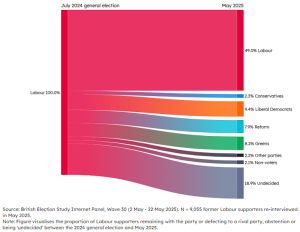
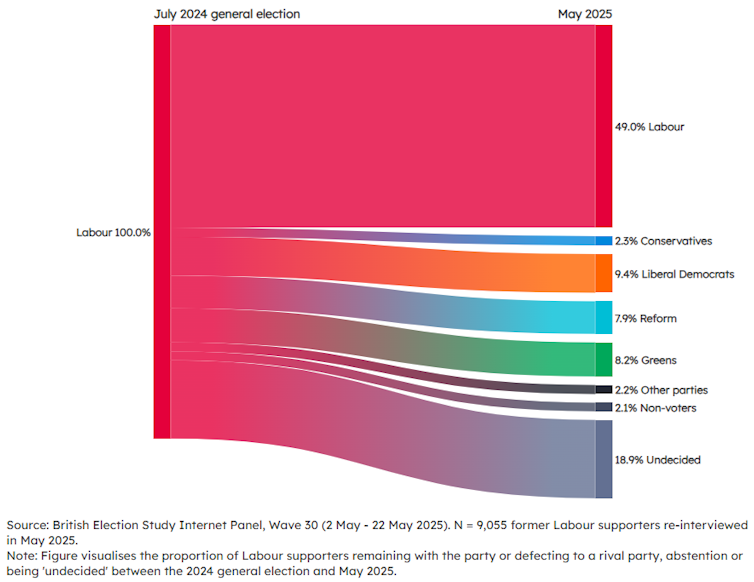
Our research argues that feelings of economic security are a key driver of Labour’s unprecedented decline in support since the last general election. Data from May 2025 reveals that only 49% of those voters who supported Labour in 2024 continued to support them. The largest proportions switched to “undecided”, the Liberal Democrats, the Greens and Reform UK.
Nuffield Politics Research Centre/Joseph Rowntree Foundation
Economic insecurity is key to explaining these losses. Our analysis tracks individuals over time, allowing us to understand whether they change their voting preferences if and when they become economically insecure.
We found that among 2024 Labour voters, moving from a state of economic security to insecurity increases the probability of switching to Reform (by 5.45 percentage points), to the Lib Dems (by 3.42 percentage points) and to “undecided” (by 4.15 percentage points). Such changes in economic insecurity – which occur among around 12.5% of Labour voters in our data – have damaging consequences for Labour.
Feelings of economic insecurity, we argue, serve as a signal of poor government performance. They are an indicator that the government has not delivered on its duties, which leads voters to abandon the party.
Furthermore, economic insecurity also makes people rate Labour’s handling of the economy more negatively. In other words, people translate their experiences of economic insecurity into wider judgements about Labour’s overall economic performance.
Our analysis of data from April 2025 shows that among the economically insecure, 44.2% evaluated Labour’s performance on the economy as “very bad”. Among the economically secure, it was only 26.5%. This matters because ratings of Labour’s economic management also influence how people vote. Improving economic security would help Labour’s reputation for managing the economy and boost its electoral prospects.
Does the budget help?
With that in mind, how far does the new budget go to address these concerns for voters?
The lifting of the two-child benefit cap will help ease economic pressure due to rising childcare costs, as well as lift an estimated 450,000 children out of poverty. Reducing the cost of energy bills will provide a boost to families, particularly those on low incomes. Increasing the minimum wage should have similar positive consequences.
Read more:
What the budget could mean for you – experts react to the chancellor’s announcement
However, feelings of insecurity are not limited to low-income households. Our previous research reveals that around one in four middle-income earners feel economically insecure.
Aspects of the budget do little to help this group. The freeze on tax thresholds will bring around 1 million more people into the higher tax rate. The freeze on student loan repayment thresholds will add to the economic difficulties faced by graduates.
Underlining these issues, the OBR estimates that real household disposable income will grow by only 0.25% per year from 2026 to 2030 – much lower than its average growth in the 2010s. With this slowdown, the economic insecurity felt by many voters may persist until the next election.
Economy v immigration
Once budget headlines have faded, Labour will once again face questions over whether it should prioritise the economy or immigration – the two key issues for the British electorate. Our research provides a possible answer.
We find that economic insecurity is a broader explanation for Labour’s vote losses than concerns about immigration. Becoming economically insecure leads voters to abandon Labour for Reform and the Lib Dems, as well as pushing voters to “undecided”. In contrast, becoming more opposed to immigration only leads Labour voters to Reform.
Addressing the issue of economic insecurity could stem the tide of Labour defections across the political spectrum. A hardline approach to immigration is likely to only appease the smaller group who are going to Reform (around 10% of 2024 Labour voters). It could also alienate former Labour voters who oppose this approach, potentially worsening Labour’s popularity overall.
Prioritising economic insecurity appears the most sensible political strategy for Labour, potentially leading to vote gains across the political spectrum. It would, of course, also arguably bring benefits to the population at large. The budget has taken steps to meet this goal, but may not go far enough to restore the economic positivity that Labour needs.
Justin Robinson does not work for, consult, own shares in or receive funding from any company or organisation that would benefit from this article, and has disclosed no relevant affiliations beyond their academic appointment.